Team of 1000s
Building Wyoming’s future is a shared mission.
Team Wyoming
At the Wyoming Business Council (WBC), we know that building a prosperous and sustainable economic future is too big a job for any single agency, organization, or person. We are collaborative catalysts for progress, and we embrace our state’s pioneering spirit with a “Team of Thousands” philosophy that defines our work.
This isn’t just our team; it’s every local leader, passionate business owner, community partner, and dedicated citizen across Wyoming. We are collectively moving toward a single, optimistic, and bold vision, confident that by working together, we can overcome any obstacle and architect a thriving future for generations to come. Join the pioneers.
MOBILIZING THE TEAM OF THOUSANDS
JOIN A JAC WATCH PARTY – THURSDAY, DEC. 4, 2025
The Wyoming Business Council believes that building a more resilient, prosperous, and sustainable economic landscape requires informed, collective action. That’s the Team of Thousands philosophy.
We invite you to participate in a crucial step of the legislative budget process by joining a statewide JAC Watch Party. This is your chance to:
Observe the Vision: See the WBC present its Vision for a More Resilient Wyoming Future to the Joint Appropriations Committee and learn about the strategic investments and “big bets” needed to reverse economic decline and retain our talented youth.
Organize Locally: Connect with fellow citizens and community leaders who are ready to work together to understand the process.
Learn to Engage: Get the tools to share your vision with decision-makers.
Change is a team sport. Find a watch party near you and commit to shaping Wyoming’s future through participation and awareness.
Date: Thursday, December 4th Time: 2:00 PM – 4:00 PM RSVP: wbc.pub/JAC_WatchParty
Watch Party Locations:
- Casper: Casper College Walter H. Nolte Gateway Center, Room 225
- Cheyenne: Wyoming Business Council office
- Gillette: Gillette College Technical Education Center Presentation Hall TEC213
- Laramie: University of Wyoming College of Business Green Johnson Student Success Center Commons
- Powell: Northwest College Student Center, Room 100
- Riverton: Central Wyoming College Intertribal Education and Community Center
- Rock Springs: Rock Springs High School Auditorium (*Note: A valid ID is required for admittance.)
Myth Busting and Building Hope
We don’t accept the myth that economic decline is inevitable. As the optimistic architects of Wyoming’s future, the WBC is committed to confronting challenges head-on with bold action and hope. We use data to identify and dismantle the systemic barriers holding us back, proactively proving that sustainable, long-term prosperity is absolutely within our reach.
Our CEO, Josh Dorrell, headlined a Wyoming Tax Facts Lunch & Learn webinar where he candidly discussed Wyoming’s shrinking economy and the path to better opportunities for businesses, workers, families, and future generations. Throughout the presentation, he busted some common myths about Wyoming’s economy.
Watch the recording and let us know what you think of the bold alternatives the WBC is proposing to make our resilient vision for the Cowboy State a reality.
Myth: Our economy is just fine.
We’re often told our economy is doing fine, but the numbers tell a different story. Our state has seen a long-term decline in GDP, including flat wages, shrinking employment, and, most concerning of all, our youth are leaving the state at almost twice the national average. Ignoring this reality means missing opportunities to make essential changes and keep our families intact.
Myth: The private sector will take care of it.
Some believe the private sector alone can solve our problems. While we are champions of free enterprise, limitations on what private industry can do alone exist. Wyoming is competing with states that invest heavily in infrastructure and business attraction, which creates a vicious cycle – pulling our talent and firms to larger cities. Private businesses need the right environment to grow, and sometimes that requires surgical, precise government action – not small government, but government that’s exactly the size it needs to be and no larger.
Myth: Wyoming is broke.
While it’s true that our future revenues are uncertain, that does not mean we are broke. The reality is we have significant savings. Wyoming has a “rainy day fund” of about $1.5 billion, which means we can operate our state government for almost a year (302 days) without any revenue.
To put that into perspective, that is more than twice as long as the second-place state, Alaska.
We love to double down on what we are good at in Wyoming, but this is a case where we are unnecessarily secure. We could invest $778 million into our state’s future and we would still be number one in the nation for fiscal security.
We have the resources, and we have the opportunity to invest in a much more certain future, one that we decide for ourselves.
Myth: Nobody knows what to do.
That’s simply not true. We are developing bold initiatives like a critical minerals laboratory we’re commonly referring to as “Wyoming Labs,” to attract giant brains and foster research and development that will make the pie bigger for everyone. (Check out this short AI-generated synopsis of a recent board meeting for more details.)
We’re also reaching out to people across the state at all levels to better understand the challenges YOU are facing in your communities. We’re bringing people together to tackle these challenges and create our shared vision of a thriving Wyoming.
Myth: Most people don’t want Wyoming to grow.
This is a myth we have believed for a long time at the WBC. We thought, just like many of you, that the large majority of Wyomingites are opposed to growth and change. After all, that’s the rhetoric we hear and read every day.
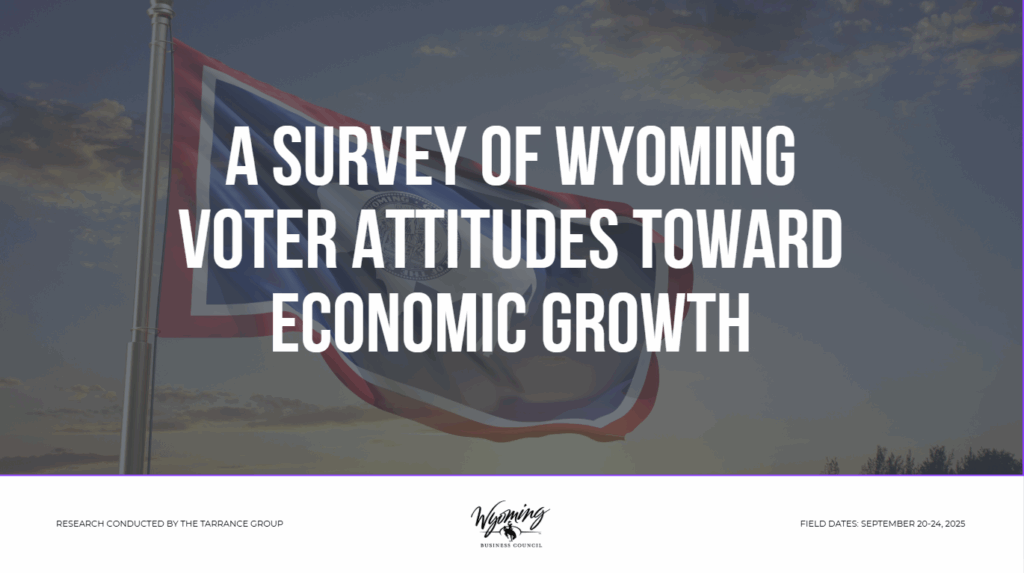
However, according to a recent poll of Wyoming voters, three-fourths of people (73%) support a future where people and businesses are moving in, bringing new jobs, services, and opportunities, along with new challenges such as increased traffic, housing development, and changes in community dynamics that might come with that growth. Plus, 8 out of 10 people favor their local community taking strong action to grow its economy and job market.
We should be empowered to know that we are not alone, and the majority of Wyoming people support increased economic opportunities to keep our kids here.
Myth: Nobody wants taxes to increase.
When we conducted our poll of Wyoming voters, we thought for sure we would hear a resounding NO to paying slightly higher taxes to bring jobs and support economic opportunities. While the majority did say they are opposed to higher taxes, more than 1/3rd of people (35%) are in favor of them.
These are our people. These are the people we need to connect with to build this coalition and ask those who said “No” to higher taxes how they expect to pay for the growth and opportunities they almost resoundingly said they want.
Encouragingly, 4 out of 10 people aged 18 to 44, and half of the people who believe Wyoming’s economy is in decline, support paying taxes. We can work with that!
Myth: We have time to wait it out.
Time is not on our side, and nobody is coming to save us. Our state’s economic trend is urgent. Successful development takes years, and we don’t have decades to wait.
We have a bold vision. We have proven strategies that are delivering results on the ground. This is how we begin to reverse the decline and create a future of abundance.
Myth: Someone else needs to tell us what to do.
Nobody is coming to save us. Waiting for an outside force to solve our problems is not a strategy; it is a surrender to the very economic trends that are pulling our communities and our children apart. We do not have time to wait.
The reality is, we lead. We do not need anyone to give us permission to paint a vision for Wyoming that is positive. We have the ability, right now, to make the hard decisions and put the pieces in place to build a future of abundance.
This leadership does not belong to a handful of people in Cheyenne. Reversing our state’s economic decline is a mission that belongs to all of us. It is the work of a “Team of Thousands”, a coalition of citizens across the state who are willing to have the courage to act.
We are committed to making the hard decisions and investing strategically to secure a prosperous future for all of Wyoming, and we can do it with you by our side.
This is our invitation to join this team. Share your story and join us! How are you feeling these challenges? What ideas do you have for the future?
We want to work with YOU!
Wyoming Supports Growth
The Wyoming Business Council conducted a statewide poll with support from a third-party research partner, The Tarrance Group, measuring voter attitudes on economic conditions, development priorities, and community growth. The results reveal a strong mandate for proactive, community-led growth and a clear consensus on the urgent need to retain our young people to build resilient communities.
The survey of 514 registered voters, conducted Sept. 20–24, 2025, paints a picture of a state that is pragmatic yet fundamentally optimistic. While residents acknowledge economic headwinds, they are ready to roll up their sleeves and build a stronger future, expecting their local leaders and private sector partners to lead the charge.
Building Wyoming's Future
The WBC is hosting a series of essential community conversations exploring Wyoming’s biggest economic growth opportunities and discussing practical steps needed to secure a thriving, resilient future for generations to come.
These conversations are vital for everyone in our Team of Thousands – local leaders, business owners, students exploring opportunities to stay in Wyoming, and dedicated citizens – who want to play a direct role in building a thriving, resilient future for generations to come.
The first of our community conversations explores how major new developments – such as the proposed BWXT nuclear facility near Gillette, Wyoming – can serve as powerful catalysts for statewide economic growth and opportunity. Watch the conversation with Business Council CEO Josh Dorrell and community and industry leaders.
REGISTER NOW FOR OUR NEXT CONVERSATION IN THE SERIES
Join us for another engaging virtual forum – “Building Wyoming’s Future: Critical Minerals Beyond the Rocks” – exploring how Wyoming could go beyond extracting rare earth elements to building a comprehensive value chain that leverages our state’s greatest asset: our people and their ingenuity.
Tune in Wednesday, Dec. 17, 2025, at 12:30 p.m.
Wyoming’s Advanced Nuclear Opportunity: Community Q&A
How will BWXT ensure high-quality, long-term jobs rather than a short-term boom?
This is not a “boom-and-bust” model. It is a generational anchor industry, and key drivers include
- Decade-scale facility lifespan under NRC licensing
- Prioritizing local hiring and upskilling
- Building a strong, local supply chain
- Working with colleges and communities for ongoing workforce development
- Integrating into the community over a generation, not a project cycle
I’m a young Wyoming resident studying nuclear engineering with limited experience. How can I contribute to this state and to the nuclear field?
- Start with two steps: gain real-world experience and share what you know.
Seek internships or co-ops with BWXT, TerraPower, national labs, or engineering firms. Hands-on experience will matter as much as your degree. - Be a local “explainer.” Talk with friends, family, and community groups about what modern nuclear energy looks like today. Staying connected to Wyoming projects now will position you well as opportunities grow.
Gillette has a strong workforce from coal and industrial operations. How do these skills fit a TRISO fuel facility, and will training be provided?
- These existing skills and know-how fit very well. Skills from coal plants – maintenance, operations, safety, instrumentation, valves, pumps, quality – are directly relevant to a TRISO fuel facility.
- Training will be essential. We expect to develop targeted programs in partnership with Gillette College, the University of Wyoming, WyoTech, Wyoming Welding Academy, and employers like BWXT and L&H. The workforce that powered Wyoming’s legacy industries can transition into advanced nuclear with the right support.
What specific training could colleges offer to advance the nuclear workforce?
Training should be practical, employer-aligned, and accessible. Colleges can serve as a bridge between today’s skills and tomorrow’s jobs by offering a variety of training opportunities, including
- Certificates in nuclear quality, radiation protection, and process operations
- Short, stackable credentials in advanced manufacturing
- Co-developed courses with industry
- Built-in internships or co-op rotations
- Technical training tied directly to employer needs
Will BWXT or L&H partner with Gillette College, UW, or others to train Wyoming residents for TRISO manufacturing or microreactor work?
- Yes. Partnerships with local colleges and training providers are expected. These may include curriculum design, advisory roles, internships, apprenticeships, and on-site training to ensure Wyoming residents are first in line for these careers.
- L&H partners with Gillette and Sheridan College, UW, and many other community colleges, trade schools, etc. We get our best talent by working with the teachers and finding students who match our culture and fit in our mission, vision, and values. The world changes faster each year, so L&H looks for people who want to perpetually upgrade their skills, abilities, and opportunities. Training on the job is the norm for L&H.
How can we help K–12 students understand the career opportunities emerging in Wyoming?
The message to convey to our young people is simple: you can build your life here doing world-class work. We recommend introducing energy and advanced manufacturing careers early through:
- School visits from engineers, welders, and technicians
- Hands-on clubs (robotics, energy clubs, machining basics)
- Field trips to training centers or industrial sites
- Classroom kits that connect STEM skills to Wyoming jobs
- Teacher training and lesson plans tied to local industries
Can we bring nuclear education or training classes to Carbon County and other regions?
Yes. Regional interest makes this easier. Carbon County Higher Education Center and others can work with project partners to pilot short courses on nuclear fundamentals, safety, energy careers, and technical skills aligned to future jobs.
How can a small business get networked or involved with the advanced nuclear sector?
Small businesses in Wyoming are already winning major contracts, and more can join them. Visibility and clarity are key:
- Attend supply-chain tours and business roundtables
- Submit capability statements to BWXT, TerraPower, or other project partners
- Join networks like Wyoming Innovative Entrepreneurs
- Demonstrate quality, safety, and reliability even if not yet “nuclear-qualified.”
How can electrical professionals and technical organizations support nuclear development?
Organizations should connect with BWXT, L&H, local utilities, and training providers to align skills and pursue supplier or contractor roles. Electrical expertise is essential for:
- Power distribution
- Controls and instrumentation
- Grid interconnection
- Maintenance of industrial systems
If political opposition pushes advanced manufacturing away, will companies expand elsewhere?
- Yes. Companies investing hundreds of millions of dollars will go where they can operate with certainty, predictability, and a welcoming environment. We’ve already seen this happen with other companies looking to expand in Wyoming that opted to move elsewhere when policy did not support their needs, irrelevant of available investments.
- Wyoming earned early advantages by being unified and forward-looking. Losing that posture would put these opportunities at risk. Companies have been clear with state leaders: political instability or hostility will send projects – and jobs – elsewhere.
Is Wyoming’s legislative direction a concern if it favors “legacy industries” over advanced ones?
- It can be. Wyoming can – and should – support legacy and emerging industries simultaneously. But if policy signals that advanced manufacturing or next-generation energy are unwelcome, growth may shift elsewhere. Wyoming’s future depends on expanding the pie, not protecting slices.
- If a company or a state decides not to innovate or iterate, it suffers. The only guarantee in business and life is change. Not everyone wants it; some want things to stay the same or even return to the past—but that’s the one impossible thing. If we engage in change, we can help shape it and lead it. If we resist, we’ll be dragged into it anyway, without any of the rewards of being the creator or the leader. And remember: there’s room for all forms of energy. When any product or energy source hits peak demand and stops evolving, competition squeezes out the profits and eventually erodes wages and benefits. The path forward is to keep the profitable legacy industries while pushing into new products and services that aren’t price-sensitive. The right strategy is all of the above—and always moving forward.
As more industrial jobs come to Wyoming, how can local healthcare and community resources support workers and families?
Healthy workers and stable families strengthen long-term workforce retention. Support should be:
- Preventive: screenings, occupational health, heat, and respiratory monitoring
- Family-focused: child care, housing stability, mental health options
- Workforce-aligned: clinic hours that fit shift schedules
- Specialized: training providers in radiation medicine and emergency response (rarely needed, but important)
Can healthcare resources be tailored specifically for the nuclear sector to attract more investment?
Yes. Specialized clinical training, emergency preparedness, mental health support, and family services can all signal that the region is ready to support advanced industries. This is another competitive advantage communities can use to leverage themselves.
How will industry leaders maintain transparency, given past failures in other energy sectors?
Trust is built by inviting good faith scrutiny, not avoiding it. Transparency requires:
- Early and ongoing communication
- Plain-language explanations of safety and risk
- Independent oversight and regulatory rigor
- Willingness to share both successes and mistakes
- Community advisory groups with real access to information
What risks or challenges exist in bringing nuclear industries to Wyoming? What policies are important to ensure responsible development?
Responsible development means clear rules, enforced consistently, not no rules.
Potential key risks:
- Political volatility
- Public misinformation
- Workforce bottlenecks
- Infrastructure capacity
- Complex permitting
Important policies:
- Stable, predictable regulatory frameworks
- Proactive community engagement
- Workforce and education investment
- Infrastructure readiness
- Clear environmental and safety guardrails
Where can the public find unbiased information about nuclear impacts?
Look to independent and science-based sources, such as:
- National labs
- Universities
- Federal regulators
- Global case studies of long-standing nuclear communities
How should AI be discussed without using it only as a justification for power demand?
It should not be used as a buzzword or justification. The focus is the mission, not the hype. Instead, AI should be framed as a tool to solve real problems, such as:
- Predictive maintenance
- System optimization
- Advanced operator training
- Enhanced safety monitoring
- L&H uses AI to enhance the capabilities of our people, which expands the capabilities of the entire company. AI improves the speed and quality of my work as CEO and accelerates performance across the organization. At this point, it’s hard to imagine doing our jobs without it. AI is a force multiplier for productivity, quality, safety, and speed to market—enabling us to take on projects we would have passed on in the past. The companies and teams that embrace AI to compound their capabilities will grow faster, create more financial freedom, and achieve a healthier work-life balance than those who resist it.
Will panelists support state agencies seeking nuclear or AI-related grants?
Yes. Leaders are generally willing to contribute expertise, letters of support, brainstorming, or partnership roles—especially when the project:
- Strengthens Wyoming’s workforce
- Advances safety or innovation
- Aligns with long-term economic goals
Agencies should reach out early with clear, concise requests.
How can WyoTech and similar programs become part of this opportunity?
WyoTech and similar programs are natural partners for the scale of this emerging opportunity, and can collaborate directly with industry on:
- Specializations such as nuclear-quality welding
- Diesel and equipment maintenance programs for plant support
- Internships, apprenticeships, and employer-aligned curriculum
- Student pathways into high-quality, long-term jobs
Partnership with the Harvard Growth Lab
The Wyoming Business Council and in-state partners are working with the Harvard Kennedy School’s Growth Lab to identify and address the various constraints that are inhibiting growth in the Wyoming economy.
We consider growth synonymous with prosperity. Together with the Governor’s office and other state and local partners and stakeholders, we are focused on establishing systems that put more dollars into the pockets of the people of Wyoming by growing opportunities and opening markets; creating an environment where people, businesses, and communities can thrive.